Identify Fall Travel Routes by Mapping Rub Lines Now
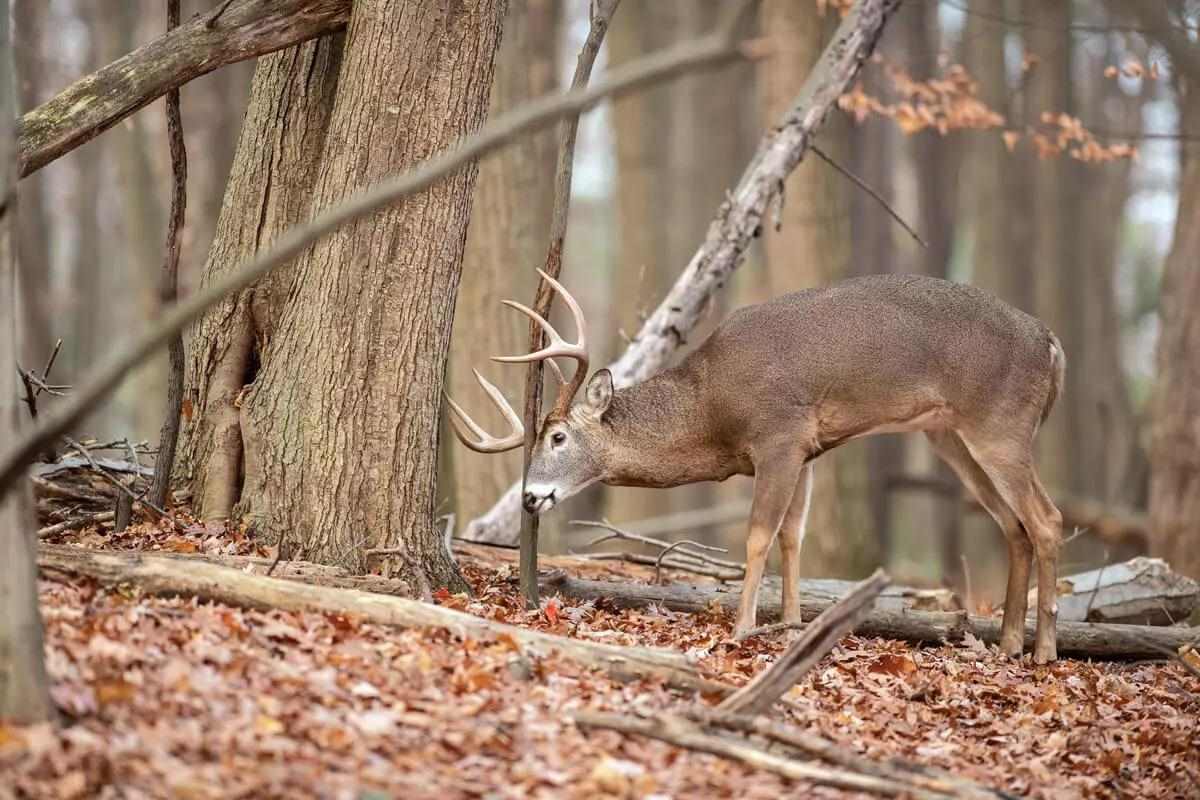
A buck rub is indicative of a road sign on a deer highway, and these “sign posts” can provide us many clues about how male deer move throughout a landscape. For instance, we can determine direction of travel (one or two way, based on side of tree rubbed), and paths to and from bedding areas and staging areas. (Photo by Matt Hansen)
June 13, 2025
It is my firm opinion summer scouting is where it all begins, and it leads to the successful harvesting of a trophy whitetail more than any other activity. But, it’s summer, and it’s hot; and there are insects and snakes! Well, do you want to be successful next season or not? If you’re willing to deal with the discomforts in order to better your odds of tagging a buck come fall, let’s talk summer scouting.
I’ll begin with a brief reminder of what we learned about buck behavior. When we first began radio-tracking bucks from yearling through maturity, we discovered that yearling bucks tend to make a strange journey out of the home range of the doe group during their first fall. Often, they return to the origin range for a short time, then a good percentage of them take off their second year and go to a place we have seen them visit on that original voyage.
A percentage of bucks continued to use that new location as their home area throughout their lifetime; while others tended to take a long journey each fall during the rut. We later dubbed these two types of bucks Dominant Residents and Dominant Floaters. The latter were the hardest to keep track of, as the timing of their movements were not consistent.
We also learned that bucks tend to have more than one sanctuary, coinciding with the season, and returned to these as the year progressed. Then we learned that bucks are not early risers, and make predetermined trips to areas, we named Staging Areas, arriving there right at dark. On arriving, they worked several “Sign Post” rubs, and depositing scent on these, that not only communicated with other deer, but conveyed their social position. The bucks remained in and around the staging area, until just before daylight, then headed home to their sanctuary. Hunters seeing bucks in the early morning incorrectly interpreted that the bucks were just starting to move, when in fact they were heading home from “work!”
Advertisement

The paths taken to feed or to reach staging areas we named “Travel Corridors,” because this term better described what they were than “deer runs.” Travel corridors connect beds, feeding areas and sanctuaries. In the fall, when a buck gets up from his bed, his serum testosterone is at its highest level. That makes him aggressive and prone to rubbing trees, especially immediately around the bedding area. Rubbing continues as the buck walks down one of his travel corridors, but tends to fall off in numbers as the buck gets farther away from its bed. As he approaches the staging area, he tends to “puff back up,” and makes more rubs. If you could see this entire track from above, it would be shaped like a dumbbell, with more rubs on each end.
We also learned to think of travel corridors as “highways,” with some being one-way and others two-way. How do we know? We learned from telemetry. This is also supported by the fact that some travel corridors only have trees rubbed on one side, and others on two sides.
A sanctuary bed has extremely “telling” structure and appearance. There is an accumulation of fecal pellets, the bedding area shows a well-worn depression in several areas; however, the best tell is that trees are rubbed in almost a perfect circle around the core bed! There also are demonstrable rub lines leading to and from the bed, two or three in number. But, at this point in our discussion you may be asking, “What does all this have to do with summer scouting?”
Advertisement
Well, let’s find out!
FINDING THE KEY ELEMENTS
The “deer highways,” or travel corridors, are marked by rubs by the buck as he travels the same paths everyday. Our studies for almost 40 years clearly support that a buck will continue to use the same travel corridors year-after-year, unless there is a significant disturbance, or the habitat changes dramatically! So, what you end up with on any property is an almost permanent record of where the bucks have traveled for years; monumented by rubs of various states of use.
When is the best time to go looking for rubs? You guessed it, the summer! Just start anywhere on your property and walk a grid pattern, looking for rubs of any kind — live trees, dead trees, it does not matter. Once you find your first rub, you have hit the edge of what amounts to a “deer highway.” Now, turn and look in all directions and try to find out which way(s) the “road” travels. In the old days, we used an aerial photograph and tried to pinpoint the location of each rub on the image.

Then we switched to GPS units, which were only available to scientists; then to one of the many mapping apps now commercially available such as onX Maps. If you are using one of the apps, just tag the location of each rub and try to designate them in your data as one of these three: one way, two way and signpost. A signpost will be located as a cluster and be on a larger diameter tree, which will show multiple years of use.
It may take more than one summer to complete this task, but when you are finished, step back and take a look at the map you have created! You have a travel map of deer in your area. We long ago took it one step further, by using sophisticated Geographic Information Systems (GIS) to create what are called “Heat Maps” for the distribution of rubs, scrapes and signposts.
You can see several examples of this GIS mapping software in this article’s attached artwork. Refer to the cutlines for explanations of each graphic.

So, what do these graphics have to do with your summer scouting? It turns out you can do the same kind of analyses in a much simpler way! Here’s how. Using one of the hunting apps, such as onX, or simply a large print of an aerial photograph of your property, conduct a thorough search for rubs, scrapes and signposts. Indicate each by saving them as “waypoints” or markers on your map.
The next step would be to scout out factors that might make deer travel one corridor more than another this year; for example, a motte of oaks that are heavily loaded with acorns, crop rotations, abandoned fields that might grow up and serve as summer bedding areas, recent timber thinning activity, etc.
BUCK KNOWLEDGE ZONES
The white-tailed deer is innately curious and is always investigating objects and activities within their home ranges. We performed an experiment where we hung white handkerchiefs around the forest and placed trail cameras on them. We obtained a large number of photographs of deer inspecting the handkerchiefs! It is adaptive to them to know every inch of their home range; however, it is not possible for them to learn every detail!
The mapping work I discussed earlier demonstrated that bucks do not visit every inch of their home range, and some areas are seldom visited. We developed the concept of “knowledge zones,” which occur in the immediate areas around their bedding areas and where they commonly feed. A buck generally sleeps late, rises and then makes a decision to travel to a specific place. He works the signposts around his bedding area, then heads for some destination for the night. As he leaves his bedding area, he eventually goes on “cruise control,” not paying as much attention about what is going on along the trail. He also is generally less aggressive in these areas, making less rubs and scrapes.

As he approaches his destination, often a staging area, his interest increases, and knowledge of the area kicks in! His blood testosterone level increases, and he behaves like a young boy approaching a playground; he becomes more aggressive, making more rubs and scrapes. When you are mapping the rubs on your property, you will notice that there are portions of the travel corridors that have many times more rubs than others.
I do not recommend setting up right adjacent to Staging Areas or Sanctuary beds. Rather, map out the rub lines to and from these features and find candidate locations where the density of rubs tapers off, proceeds sparsely for a distance, then picks up again in higher numbers. In other words, I select the bar of the dumbbell for my setups. You will find several places meeting these criteria, and your decision as to which one will be your setup location will often depend on wind. I designate several and decide exactly where just before the hunt. I never force the issue! Why waste all that hard work?
So, summer is indeed the best time for scouting your hunting territory. The bucks are more than happy to leave markers on their travel corridors; all you have to do is map them out!
Video That May Interest You
link